It began innocently enough.
Over the past two years I’ve observed my company discover AI. Or rather, discover the performance of AI adoption.
C-suite started paying lip service to AI in all-hands meetings. The IT department began circulating promises of officially procuring AI tools. Grandiose assertions of impending AI-driven innovation rippled through the corporate zeitgeist. As the global AI hype swelled, so did the C-suite’s FOMO. Soon enough they commissioned an initiative to develop a formal AI Strategy™, an attempt to tame and harness the rapidly evolving beast.
Eventually, after failing to curb the proliferation of ‘unauthorized’ use of public AI tools, the IT department finally rolled out an enterprise subscription to one of the major LLM products. Congratulatory emails proclaimed a new era of efficiency. Internal memos circulated with vague instructions for revolutionizing work through the power of AI. The travelling AI circus had arrived in town, and the introductory attraction was on show: the personal productivity chatbot.
But this was only a sideshow attraction for the upcoming rings of the big top, and not only did I have a front-row seat to the show, I frequently found myself pulled into the ring to be shot from the cannon. Except the trajectory was stuck in committee purgatory, and the cannon crew were discovering gunpowder for the first time.
Disclaimer
Before the circus begins though, allow me to clear the air: I am not anti-AI. I come from a data science background, back when AI was more commonly known as machine learning. I have a firm grasp on how these models work, including the contexts in which they don’t work. I use LLMs frequently myself, albeit selectively and with due skepticism. And I’ve built bespoke implementations of LLM capabilities. This is not a diatribe against the technology itself. This is an observation of how corporate AI adoption has become a performance divorced from substance, where spectacle actively impedes thoughtful implementation.
As incredible and fascinating a technology as it is, the staggering AI hype gripping the world is beyond not just reality but even absurdity. I’m confident AI is here to stay but I don’t claim to know its exact future, and anyone who does is deluded at best and a downright snake oil salesman at worst. What I do know is the hype machine is in full force for one main purpose: a desperate attempt to retroactively justify the untold billions of dollars burned in pursuit of the technology. And this rift between hype and reality has given rise to the AI circus performing at nearly every big corporate environment near you.
Act One: The Prompt-a-Thon
One of the hyperscaler companies, who we’ll call Hyperscaler X, offered to help my company discover AI use cases. The designated format for this discovery was dubbed a ‘Prompt-a-Thon’, a bastardization that dishonored the once-great hackathon tradition. The prompt-a-thon would be run for a specific business unit in the org, who we’ll call Business Department, and thus a full-day meeting barged its way into the calendar of every member of that department.
I was invited to this event to perform two roles: educator and technical specialist. First I would present during the introductory ‘context setting’, and then I would help the participants refine and implement their ideas. Picture a hackathon where instead of teams of developers you have teams of ideas-people throwing everything at a singular developer desperately trying to catch even one feasible implementation.
After generic introductions from Business Department leadership and IT Department leadership, I entered the ring for my first performance. I attempted accurate but approachable definitions of AI and its surrounding terminology, butchered my way through an abridged history of the field, and outlined the typical patterns for implementing it. Then I tossed a few juggling balls labelled ‘Business Department AI Use Cases’ into the air, hoping someone in the audience might catch one before I dropped them all.
Throughout my performance the audience ranged from mildly curious to mostly disinterested. I could hardly blame them though - their C-suite member was sitting front and center but more interested in tapping away on their phone than in learning about AI. Clearly all the breathless exultations of AI-led transformation were as performative as my attempted education.
Following my act was a technical specialist from Hyperscaler X who demonstrated some basic usages of their flavor of LLM chatbot. Think outsourcing the incredibly challenging task of actually reading your emails, or offloading the insurmountable cognitive load of interpreting a spreadsheet. At one point an audience member asked how the AI would handle incorrect data and, to their credit, the technical specialist admitted point blank that it wouldn’t. Then the presentation continued unabated.
With all that critical context set, the context of the main event itself was relegated to the final ten minutes. There were no goals set, no themes established, nor any workflows targeted. There was merely the nebulous mandate to go forth and re-imagine your work through the art of the prompt. Teams were randomized, ushered to their separate makeshift breakout areas, and left to ponder how to shoehorn an LLM chatbot into their jobs. The solution began desperately seeking a problem.
I was assigned as instructor to one of these audience participant groups reluctantly joining the performance. I quickly discovered that this group of people work in entirely separate teams within the department, as they spent the first half an hour simply trying to identify any workflows they even had in common. Lacking the framework to assess feasibility themselves, for every idea they would meekly petition my judgement, as if I were the only lion tamer capable of coaxing the AI beast through technical hoops.
I soon realized that most of their ideas would only be possible if they had access to the premium tier of Hyperscaler X’s LLM product. I would claim this was an intentional sales tactic from the hyperscaler, but it was equally a ‘do more with less’ budget decision from on high.
It struck me that the cost of this whole prompt-a-thon, in salaried hours and LLM compute expended, could likely have been funneled into one or two high value use cases leveraging a fit-for-purpose implementation of AI. But instead the spectacle presided, and thoughtful adoption of AI never entered the ring.
Eventually my group settled on a using the LLM chatbot to proof-read and flag errors in reports prepared by their recently inducted offshore colleagues. An AI band-aid slapped over a grievous wound of ineffective offshoring.
At the end of it all came the pitches, where each team was allocated four minutes to sell their solution. The judges were the respective C-suite members of Business Department and the IT Department, and they sat through more than a dozen pitches. Each one spilled well over the allotted four minutes, and many of them overlapped substantially in use case. The judging criteria included “Estimated Time Savings”, “Estimated Number of Beneficiaries”, and the much esteemed “Prompt Excellence”.
After a five minute deliberation and gushing assurances that they loved every team, the C-suite executives revealed a tie for first place: one solution seeking to automate budget forecasts and another attempting to triage overflowing email inboxes. Neither of these pitches had included the actual prompt used, but apparently they demonstrated the utmost in “Prompt Excellence”. The prize for all this was bragging rights, Hyperscaler X branded water bottles, and a bunch of extra work in the near future to meet leadership’s expectations of actually implementing those solutions.
Intermission Sideshow: Schrodinger’s AI Tool
Being a non-tech company our software development adjacent teams were an afterthought in the perennially in-development AI strategy, but we were eventually graced with a GitHub Copilot subscription. As the coding assistant product landscape evolved though my team sought to experiment with newer options - Claude Code was all the rage at this point. We were promptly reprimanded by IT leadership for using an ‘unapproved tool’. We assured them we had configured Claude Code to interface with our private versions of Claude in our org’s AWS environment, but we were nonetheless ordered to stick with ‘the Claude Code we have at home’, namely GitHub Copilot.
A month later, IT leadership asked me to estimate the potential AWS usage costs of the aforementioned Claude Code setup. As anyone familiar with AWS knows, estimating usage costs borders on divination. Add token-based LLM pricing and the mysticism becomes outright sorcery. I submitted what I thought was a conservative estimate on the higher side. Turns out Claude Code churns through a short story worth of tokens even initializing itself in a repo, and then entire novels for any actual task you give it. I guess my under-cooked estimate didn’t matter though, because a week or two later IT leadership announced they were officially rolling out Claude Code to all developers. Innovation was celebrated once more.
Following this about-face, I found myself at the desk of one of our IT department leaders, and on their screen I spied a familiar interface. They enthusiastically explained how they were using Claude Code to generate Product Requirements Documents for one of the developer teams. The irony stung, but I didn’t have time to dwell on it because we were heading out to a very important meeting: Hyperscaler X were hosting our leadership team for an AI briefing session. A session I had been invited to with zero context, but as it would turn out, this didn’t matter in the slightest.
Act Two: The Executive Meeting
Hyperscaler X had recently moved in to one of the new flagship office buildings in our city, and our meeting was on the floor whose sole purpose was for entertaining clients. Panoramic skyline views, pristine high-end office fit-out, fully stocked kitchen, and a complete lack of any actual employee workspaces. All the trimmings befitting a meeting of executives. We exchanged pleasantries over freshly catered pastries paired with coffee and soft drinks, and the cast of the performance were introduced.
The ringmaster on the hyperscaler’s side was a Vice President - a time-honored meaningless corporate title, but discernible in this context as the designated schmoozer. And they set about rubbing shoulders with our CTO. The supporting performers included an account director, an account executive, another relationship manager type role whose official title escapes me, and two actual technical operators: a pre-sales engineer and a technical architect. With the performers introduced, we were ushered into the Big Top that was the meeting space itself.
The meeting room seemed as much a functional space as a statement of hyper-modern interior design, posed with unnecessary flourish. Four rows of seating alternating plush ottomans with sleek winged chairs, each flanked by coffee tables with precisely aligned sparkling water jugs for every single audience member. Each coffee table even included its own power outlet sporting both USB and ethernet ports - as if anyone would be working. And all of this facing a comically over-sized ultra-ultra-ultra-wide projector screen, on which were arrayed giant profile shots of all the attendees, staring blankly over the room. We chose our seats, poured our sparkling water, and settled in to watch the show.
The session commenced with a welcome address from the account executive who made sure to applaud our org for engaging in such a fruitful partnership. They then gave everybody thirty seconds to introduce their name, position and background. Most of these intros ballooned into several minutes and meandered well away from personal introduction and into bold-faced flattery of the ‘partnership’. After a hearty round of back-patting, the account executive handed the proverbial mic over to the VP for the keynote performance.
The VP opened with a lofty but largely substance-free sermon heralding the age of AI and declaring that its transformative impact on businesses, and the world in general, was already at hand. They quoted some think-tank ‘study’ projecting over a billion AI agents being created within the next three years - apparently their measure of AI’s impending value. Their next measure was a reference to another large company that was making AI agents ‘officially part of the org chart’, with every human employee now becoming ‘a manager of AI team members’. They weren’t quite done beating this dead horse until they hammered in some further stats about the volume of AI agents deployed within other large companies they work with.
Next came the forward-thinking pivot - the VP established a categorical generalization that businesses to date were adopting ‘productivity AI’. The ‘AI’ part apparently comprised tools such as LLM chatbots or copilot assistants. The ‘productivity’ part was left mostly undefined and entirely unsubstantiated. The future though, they proclaimed, was the fabled ‘agentic AI’. I’ve heard various attempts to define this term, and I’d even attempted my own during the prompt-a-thon, but I didn’t even get the chance to hear the VP’s attempted definition because they instead asked our permission to visually illustrate their point.
They strode over to a conveniently placed digital whiteboard, fumbled briefly with the digital pen, and then drew a set of axes. I had some ideas for what plot might come next: AI value versus time, AI value versus data volume, etc. Instead they gestured at the vertical axis to say “So if you imagine that this is today,” and then to the horizontal axis “and this is tomorrow.” It took all my self-control not to deafen the room with raucous laughter. They proceeded to draw two lines on this plot, like so:
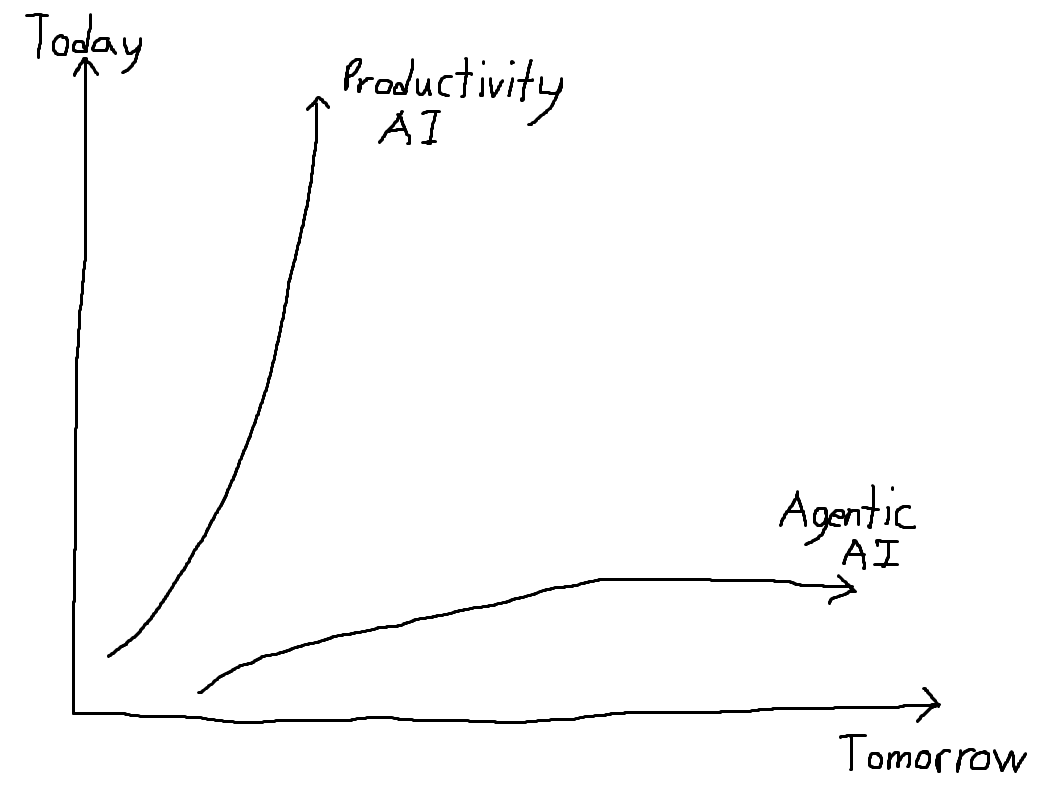
I scribbled this down later when I got home, as some form of proof that this actually happened. I don’t recall how the VP concluded their presentation because I was still pondering the perpendicularity of today to tomorrow. I guess they were satisfied they’d visually illustrated their point though, because they soon handed over to the technical architect.
The technical architect led with an admission that the marketing team had mandated the inclusion of two slides upfront in their presentation that ‘establish branding’, then promptly skipped over said slides. They delivered a primer on AI itself, and I sympathized with them given my similar performance at the prompt-a-thon a month earlier. Abridged definitions and explanations of deeply nuanced technical topics. Overly simplified attempts to visually convey said technical topics. And an audience mostly incapable of truly grasping the content.
Eventually they reached the buried lede though: a pitch of a seemingly unending deluge of new AI related products the hyperscaler was about to flood into the market. They admitted they didn’t even have time to name all of these new AI products, let alone give brief insight into their supposed purposes. In typical hyperscaler fashion, two of the new product names could immediately be mistaken for names of their other existing products, just with the word ‘agent’ jammed in.
I couldn’t begrudge the technical architect any of these contrivances though, they were a captive in this performance as much as I was. They were the bear riding a bicycle at the ringmaster’s behest. I would later have a much more meaningful one-on-one conversation with them, technical operator to technical operator, including how exactly these new products would work and a general exchange of views on the genuinely valuable use cases for LLMs.
You see, after the technical architect’s presentation the agenda originally included a tour of ‘innovation showcase’ stations around the floor. But this was cut from the agenda to ensure we had time for the real main event of the performance: they needed to take us out to dinner at a fancy restaurant. And with that, save for my heart-to-heart with a fellow subject matter expert, all pretense of a briefing on AI was dropped.
Act Three: The AI Strategy Workshop
Two weeks later I was invited to a workshop centering on our org’s AI strategy. The strategy that had been ‘in development’ for nearly two years now. Whilst I hadn’t been in the tent for this strategy until this point, I had previously been asked to contribute content for the people that were. This had largely consisted of cataloging existing usages of AI our team had spearheaded, to be listed on a brag sheet to the board of directors. Many of these examples had generated little to no actual value, but were included nonetheless for the optics of appearing AI-forward. Now, once more, I was being pulled into the ring itself.
The workshop’s premise was to ideate and refine high-value ways to use AI in the org, from ‘everyday productivity’ through to ‘genuine game-changers’. This would primarily involve augmenting the workflows of the various rank-and-file employees across the business, and almost none of those people were in the workshop. Instead it consisted of IT department leadership, a couple of members from core IT teams, a few members from the data team, and a dedicated ‘strategy consultant’ facilitating the whole event. The CTO attended only notionally, spending most of the workshop in other meetings.
The core activity was the corporate workshop mainstay of a post-it note brainstorm with rapid fire ideas hastily scribbled and slapped onto whiteboard sections arbitrarily categorized according to business workflows. As you can imagine, a post-it note has just enough real estate to vaguely gesture at a idea and nothing more. Innovation half-baked in large batches of barely articulated thoughts. These half-baked ideas were then mashed together based on squinted resemblances, creating even more amorphous blobs of innovation dough.
Each participant gave brief explanations as they placed post-it notes, though these varied wildly in length and specificity. Some ideas simply invoked currently in-vogue AI features with no linkage to actual workflows. Others pointed at business processes and asserted 'there must be something we can do with AI here.' Innovation insisting upon itself. The CTO periodically returned to the room and interjected questions that revealed a concerning unfamiliarity with how the IT teams actually operated.
In any case, it became clear that there were two entirely disjointed views of AI in the room. Half of the ideas were essentially ‘AI agent for X’, and the other half hinted at fully bespoke orchestrations of AI models. The costumed baboons and the flying trapeze artists were auditioning for the same spot in the show, and the ringmasters seemed unable to tell them apart. There was some measure of solace in the fact that the ideas would be prioritized by democratic vote. The workshop ran out of time before said voting could happen though. The facilitator assured us that a post-hoc digital voting process would suffice instead.
The next day an email arrived with a link to a voting form purportedly listing all the ideas floated in the workshop. Except many of the items were now nearly or entirely unrecognizable. This ranged from minor synonym replacements to entire phrasing rewrites. Two ideas that were originally expressed through acronyms had now been expanded in hilariously incorrect ways.
It was almost poignant that a list of AI use case ideas had been passed through an LLM and mangled almost beyond recognition in the process. Where the prompt-a-thon saw a solution in search of problems, the workshop saw the solution mangling the problem identification itself. I was watching in horror as the AI strategy ouroboros devoured itself.
Subsumed by the Spectacle
The pattern is abundantly clear. The hype has every business leader in its grip, urging them headlong into ‘AI adoption’. The operators savvy enough to fully understand the technology fade into white noise against this urgency. And the optics of AI adoption outweigh any actual value derived from it.
The hyperscalers, with their oligopoly on the compute required to host these models, churn out products and features in a desperate race to further entrench their hapless corporate clients. The VPs bam-schmoozle their executive counterparts into spending eye-watering money on said products. Leadership graces their employees with these AI products and tout them as a panacea for all organisational issues. And the rank-and-file are left scratching their heads as to how to shoehorn this mandated product into their actual workflows.
The tragedy of this is the collateral damage of genuinely great use cases for AI. These require careful discovery, deliberate and bespoke implementation, and possibly most importantly a sensible integration into existing workflows with user-led adoption. They must be pursued selectively and given the time and effort to build. Almost as if AI is another tool in the belt for good old fashioned technology solutions - an antiquated notion by now I suppose.
I’ve built bespoke AI solutions, including both generative AI based and ‘classical’ machine learning. At least some of them have actually been useful. Sentiment detection, product price prediction, LLM-powered automation of basic but genuinely necessary tasks like extracting key information from PDF files. These solutions are often quiet. A tool built for a specific problem, no fanfare.
Quiet doesn’t play well into the spectacle of the circus though. And so, if and when the circus finally leaves town for lack of ticket sales, the raw potential of those thoughtful implementations will be dragged out with it.
The Show Must Go On
But for now the global hype continues to swell, and thus the AI circus accelerates.
With every new model release, every new obscenely overvalued startup and every new billion dollar data center project, the collective sunk cost threatens to topple the over-leveraged performers. So imperative demands the spectacle continue. More rings, more acts, more ringmasters arriving with promises of transformation. And the music grows louder, perhaps to drown out the question of whether anyone actually knows what they're doing.
The technical architects are still trying to demonstrate actual capabilities. The employees who might benefit are still in the back row, or not in the tent at all. The AI strategy is a sideshow of a snake eating its own tail. And somewhere in the center ring, a vice president is still inadvertently positing that Today is orthogonal to Tomorrow.
The show, as they say, must go on. I just wish I could stop getting pulled into the ring.